Print, Erase, Repeat: The Cost-Saving Magic of Rewritable PSA Labels

Most labels have a short life. They are printed once, applied once, and thrown away. In warehouses, retail stores, and manufacturing plants, this cycle repeats thousands of times a day, and every cycle costs money-for the label material, the printer ribbon, the labor to apply and remove it, and the waste disposal.
Rewritable PSA labels break that cycle. They can be printed, erased, and printed again on the same label, often hundreds of times. The technology is not new, but it is becoming more practical and more relevant as businesses look for ways to cut waste and control costs.
How Rewritable Labels Work
The Reversible Layer
A rewritable PSA label uses a special coating that changes state-visible or invisible-when exposed to a specific trigger. The most common trigger is heat. A thermal print head or a laser beam writes the image onto the coating. A different temperature or a different laser setting erases it.
The key is that the coating is reversible. The same label can go through this cycle many times without losing its ability to show a clear image. Ricoh's thermal rewritable films, for example, can be used to erase and update text and graphics up to 500 times. Some rewritable card systems also support up to 500 erase-and-print cycles.
Two Main Trigger Technologies
There are two common ways to trigger the change:
Thermal rewritable (thermochromic): A thermal print head or a controlled heat source writes and erases the image. This is the technology behind many rewritable cards and labels.
Laser rewritable: A focused laser beam writes and erases the image without contact. Ricoh's laser system is designed for logistics labels and can be used repeatedly for more than five years under harsh outdoor conditions.
Both approaches share the same core advantage: the label stays on the asset, and only the information changes.
Where the Savings Come From
Material Cost
The most obvious saving is the label itself. A rewritable label replaces hundreds of single-use labels. In high-frequency environments-daily price tags, production batch labels, returnable container tags-the material cost drops dramatically over time.
A related concept, the double-layer label, uses "one base layer plus multiple replaceable face layers" to reduce label material consumption by more than 70% in high-frequency information-update scenarios. While not identical to rewritable PSA, the principle is the same: stop throwing away the entire label when only the information needs to change.
Labor and Downtime
Applying and removing labels takes time. In a warehouse or production line, every label change is a small interruption. A rewritable system eliminates the "print, apply, remove, reprint, reapply" cycle. The label stays on the asset, and the new information is written directly onto it.
Ricoh's laser rewritable system is described as reducing labor costs associated with label replacement and the risk of logistics system problems caused by label residue. The system is designed to be virtually labor-free for labeling operations. For operations with thousands of assets, this labor saving compounds quickly.
Inventory and Storage
Single-use labels must be stocked in multiple SKUs, sizes, and versions. A rewritable label reduces the inventory burden because one label type covers many uses. You are not holding stock for every possible batch number, date code, or destination. You are holding a single rewritable label and programming it as needed.
Waste and Disposal
Every single-use label creates waste-the liner, the face material, and the adhesive. Rewritable labels stay in service far longer, which means less material enters the waste stream. In environments with returnable containers and reusable assets, this aligns directly with circular-economy goals.
The Conditions That Make Rewritable Labels Worth It
High-Frequency Information Changes
Rewritable labels deliver the strongest return when the information on the label changes often. A pallet that moves through five depots in a week, a container that is reused daily, or a retail shelf that changes prices every morning-these are the scenarios where the cost per use drops fastest.
Reusable Assets
The label must stay on the asset through many cycles. Returnable crates, pallets, trays, and containers are ideal because they are designed to be reused. A rewritable label on a single-use cardboard box makes less sense.
Controlled Reading Conditions
Rewritable thermal labels produce a monochrome image, typically black on white or a similar high-contrast combination. The image is clear enough for text and barcodes, but it is not a full-color photograph. The application must be one where a simple, readable mark is sufficient.
A Compatible Reader or Writer
The label needs the right hardware to write and erase. A thermal rewritable label needs a compatible printer. A laser rewritable label needs a laser system. The hardware investment is part of the calculation.
How to Choose the Right Rewritable Label
Step 1: Confirm the Number of Reuse Cycles You Need
Ask the supplier for the rated number of erase-and-print cycles under your operating conditions. A label rated for 500 cycles in a lab may perform differently in a dusty warehouse or an outdoor yard. The cycle count should be supported by test data, not just a specification sheet.
Step 2: Match the Technology to the Environment
Thermal rewritable labels work well in controlled indoor environments. Laser rewritable labels are designed for tougher conditions, including outdoor logistics use. If the label will face sunlight, moisture, or temperature swings, specify a product tested for those conditions.
Step 3: Check Readability After Multiple Cycles
The image must remain legible after many erase-and-print cycles. Ask for sample labels that have been cycled multiple times and check the barcode readability and text contrast. A label that is readable on cycle one but faint on cycle fifty is not a cost-saving solution.
Step 4: Consider Custom Sizes and Adhesives
Rewritable labels are available in different sizes and adhesive types. If your asset has a curved surface, a low-energy plastic, or a surface that is cleaned frequently, the adhesive must be matched to the application. A production factory can recommend the right combination and produce custom sizes for your specific asset.
For brands using an OEM model, confirm that the factory can maintain consistent rewritable coating performance across batches. The erase-and-print behavior depends on the coating chemistry, and a batch that erases poorly or prints faintly will undermine the entire system.
Common Mistakes to Avoid
Buying on cycle count alone. A high cycle count in a lab does not guarantee performance in your environment.
Ignoring the hardware. A rewritable label without a compatible printer or laser system is just a piece of film.
Using rewritable labels for low-frequency changes. The savings come from repeated reuse. If the label changes once a year, the math may not work.
Skipping the readability test after cycling. The label must remain scannable and legible, not just present.
Not confirming batch consistency. Rewritable performance is sensitive to coating quality. Work with a factory that controls it.
FAQ
Q1: How many times can a rewritable PSA label be reused?
A: It depends on the technology and the product. Ricoh's thermal rewritable films are rated for up to 500 erase-and-update cycles. Some rewritable card systems also support up to 500 cycles. Laser rewritable systems are designed for multi-year use in logistics. Always confirm the rated cycle count for your specific operating conditions.
Q2: What is the difference between thermal and laser rewritable labels?
A: Thermal rewritable labels use a thermal print head or heat source to write and erase. Laser rewritable labels use a focused laser beam, often without contact. Laser systems are typically used for tougher environments and automated logistics applications.
Q3: Can rewritable labels be printed with barcodes?
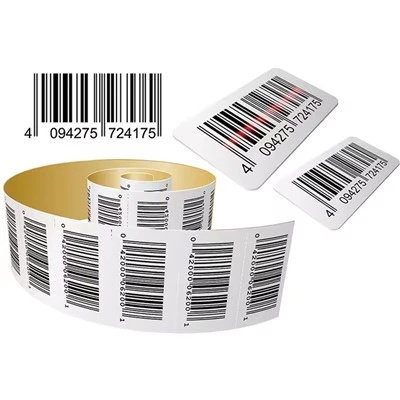
A: Yes. Rewritable thermal and laser systems can produce barcodes, text, and simple graphics. The image is typically monochrome, so the contrast is sufficient for scanning and reading.
Q4: Where are rewritable labels most cost-effective?
A: They are most cost-effective where information changes frequently and the asset is reused many times-returnable containers, pallets, warehouse location tags, production batch labels, and retail price tags.
Q5: Do rewritable labels need special printers?
A: Yes. Thermal rewritable labels require a compatible thermal printer. Laser rewritable labels require a laser writing system. The hardware is part of the total cost and must be factored into the decision.