Laser Cutting vs Die Cutting Labels: What's the Difference?
When you order custom labels, you probably spend most of your time thinking about design, colors, and materials. But there is another critical decision that happens after your labels are printed: how they are cut.
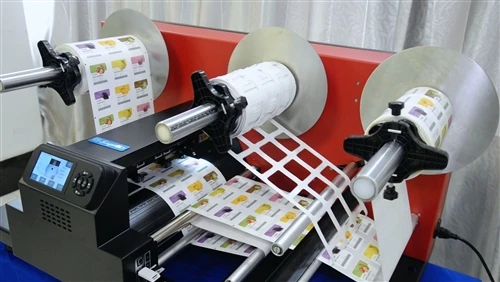
Coming off the printing press, your labels are a series of repeats on a long roll. Each individual repeat needs to be separated to make single labels. This is where cutting technology comes in-and the choice between laser cutting and die cutting has a major impact on your cost, turnaround time, and the quality of your finished labels.
This guide breaks down laser cutting vs die cutting labels in plain English, so you can make an informed decision for your next project.
What Is Die Cutting?
Die cutting is a traditional cutting method that has been around for decades. It uses a sharp steel blade or die to cut through label materials. The die is mounted onto a press, and when pressure is applied, it cuts through the material, leaving behind the label shape.
Think of it like a cookie cutter-the die is the metal shape, and the label material is the dough. The process is fast, reliable, and produces clean, consistent results.
Types of Die Cutting
There are two main types of die cutting for labels:
Rotary die cutting uses a cylindrical die that rotates at high speeds to cut labels from a continuous roll of material. It offers higher production rates and greater precision, making it the primary method for modern label production. Rotary die cutting is ideal for high-volume production and can handle complex cuts at speed.
Flatbed die cutting uses a flat press where the die presses down onto the material. Tooling costs are generally lower than rotary, but the production rate is slower. Flatbed is better suited for thicker materials and smaller quantities.
Kiss Cut vs Through Cut
Die cutting can also be classified by how deep the cut goes:
- Kiss cutting cuts through the top layer of the label material while leaving the backing liner intact. This creates peel-off labels that stay on the liner until use.
- Through cutting cuts completely through both the label and its backing material, producing individual, loose labels.
Advantages of Die Cutting
- High-speed production: Once the die is made and the press is set up, die cutting is extremely fast. Rotary systems can run at speeds that laser cutting cannot match.
- Clean, smooth edges: Die cutting produces clean cuts with no framing effect-you do not see the edges of the material.
- Cost-effective at scale: While the initial setup cost is high, die cutting is generally more cost-effective for large production runs because the die can be reused multiple times.
- Versatile: Die cutting can be used on a wide range of label materials, including paper, plastic films, and thin metal foils.
- Precision: Die cutting offers high levels of precision and consistency, ensuring labels are cut to exact specifications.
Disadvantages of Die Cutting
- Custom die costs: A custom manufactured die tool is required for each label shape and size, adding significantly to your initial order cost. Dies typically cost $50 to $500 or more per shape, depending on complexity.
- Lead time: Creating a custom die takes time-typically a few days to a week.
- Inflexible for changes: Changing a design means making a new die. This makes die cutting inefficient for frequent updates or market testing.
- Not ideal for intricate shapes: Very fine or intricate shapes can be challenging for die cutting.
- Setup waste: During the setup and registration process, die cutting can waste 8–12% of material.
What Is Laser Cutting?
Laser cutting is a modern cutting technique that uses a highly focused and powerful laser beam to cut through label materials. The laser is guided by computer-controlled optics that can cut very precise patterns.
Unlike die cutting, laser cutting does not use a physical blade or die. Instead, the cutting path is controlled digitally, meaning you can go from digital artwork to finished labels without any physical tooling.
How Laser Cutting Works
A focused laser beam melts, burns, or vaporizes the material along a programmed path-typically controlled by CAD or vector files. The laser parameters-power, speed, and frequency-are adjusted based on the material type and thickness. Because there is no physical contact with the material, there is no blade wear and no need for replacement parts.
Advantages of Laser Cutting
- No tooling costs: Laser cutting requires no physical dies, making it ideal for short runs, prototypes, and frequent design changes.
- Intricate designs: Laser cutting excels at creating complex shapes with intricate details, fine lines, and tight corners.
- Extreme precision: Laser cutting can be precise down to microns.
- Fast changeovers: Switching between different designs takes just minutes-simply load a new digital file.
- No physical contact: The contactless cutting process reduces material handling issues and eliminates blade wear.
- Minimal material waste: Laser cutting typically produces waste rates of ≤1.5%, compared to 8–12% for traditional die cutting.
Disadvantages of Laser Cutting
- Slower for large batches: Laser cutting is slower than die cutting for high-volume production.
- Heat-affected zones: The laser can cause slight edge browning or melting, especially with plastics. This is known as the heat-affected zone (HAZ).
- "Framing effect": On dark-colored labels, laser cutting can leave a visible white edge or framing effect on the perimeter. This is more noticeable on dark backgrounds applied to dark substrates.
- Higher equipment cost: Laser cutting machinery is expensive, so not every label printer invests in this technology.
- Material limitations: Not every paper or film material is suitable for laser production. Clear PP film, for example, can be challenging to cut with a laser.
Head-to-Head Comparison
Cost Structure
Die cutting loads cost into setup. Custom dies typically cost $50 to $500 or more per shape, and there is a lead time of several days to a week. However, once the die is made, the per-unit cost drops significantly for large runs.
Laser cutting has zero tooling costs. There is no die to make and no setup fee. However, the per-unit cost remains relatively constant regardless of order size, and the equipment itself is expensive to purchase.
| Factor | Die Cutting | Laser Cutting |
|---|---|---|
| Tooling cost | $50–$500+ per die | $0 |
| Setup time | 30 min – 2 hours | Near-zero |
| Per-unit cost at scale | Very low | Moderate |
| Ideal run size | 1,000+ labels | 1–5,000 labels |
Speed
Die cutting is faster once running. Rotary die cutting can operate at speeds that laser cutting cannot match, making it the clear winner for high-volume production.
Laser cutting is slower for large batches, but the near-zero setup time means that for short runs, total job completion time can actually be faster.
Precision and Quality
Both methods offer high precision. Laser cutting can achieve precision down to microns and handles intricate details better than die cutting. However, die cutting produces clean, smooth edges with no heat-related issues.
For machine-applied labels that require extremely tight tolerances, die cutting is often preferred because it is more accurate than laser cutting. Laser cutting can cause heat-affected zones on certain materials, which may affect edge quality.
Material Compatibility
Die cutting works on a wide range of materials-paper, plastic films, thin metal foils, and can handle thicker materials.
Laser cutting is also versatile, handling paper, plastic films (PET, PP, BOPP), metallic foils, and even fabrics. However, not every material is suitable for laser production, and heat-sensitive materials can be damaged by the laser.
Flexibility
Laser cutting wins decisively on flexibility. You can switch between different designs with a few clicks-no die changeover or setup time required. This makes laser cutting ideal for short runs, frequent design changes, and customized labels.
Die cutting requires a new die for every shape change. This makes it inefficient for frequent updates or seasonal variations.
Waste
Laser cutting produces significantly less material waste-typically ≤1.5%. Die cutting can waste 8–12% of material during setup and registration.
Frequently Asked Questions
Q1: Laser vs die‑cutting cost?
Depends on volume. Laser: no tooling, cheaper for short runs (<1,000‑5,000 labels). Die‑cutting: high upfront die cost, low unit cost for large batches. Break‑even varies with die expense, quantity and complexity.
Q2: Can laser cut thick materials?
Yes, but limited. It handles thick stock yet risks damaging heat‑sensitive materials. Die‑cutting is better for extra‑thick or heat‑sensitive substrates.
Q3: What is laser‑cut "framing effect"?
White edges on laser‑cut labels, typical for dark‑background designs from laser ablation. Laser cutting works best for light labels on dark surfaces.
Q4: Better for intricate shapes?
Laser cutting excels at fine details and sharp corners; die‑cutting struggles with complex contours.
Q5: Does laser cutting do kiss cutting?
Yes. Both support kiss‑cut and through‑cut. Laser cuts only top layer, keeping the liner intact.