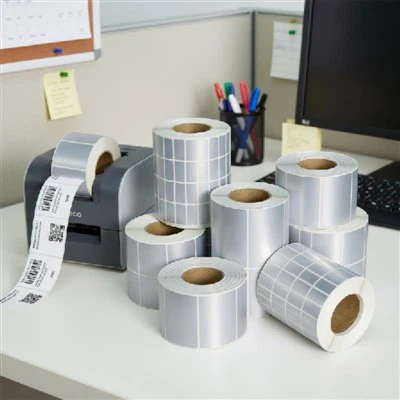
Let's talk about the safety features of PET flame - retardant labels. I'm a supplier of PET Flame-retardant Labels, and I've seen firsthand how these labels play a crucial role in various industries.
1. Flame Retardancy Mechanism
PET flame - retardant labels are designed to resist catching fire easily. The key lies in the flame - retardant additives incorporated into the PET (Polyethylene Terephthalate) material. These additives work in different ways. Some act by releasing non - flammable gases when exposed to high temperatures. For example, they might decompose to form water vapor, carbon dioxide, or nitrogen. These gases dilute the oxygen around the label, making it harder for the fire to spread.
Another mechanism is that the additives can form a protective char layer on the surface of the label when heated. This char layer acts as a barrier, preventing the ignition source from reaching the underlying material, and also insulating the label from further heat. In a real - world scenario, if there's a small fire near a product with a PET flame - retardant label, the label will not rapidly catch fire and will instead slow down the spread of the fire, giving people more time to respond.


2. Low Toxicity Emissions
When a fire occurs, the release of toxic gases can be as dangerous as the fire itself. One of the great advantages of PET flame - retardant labels is that they produce relatively low levels of toxic emissions compared to other materials. Traditional non - flame - retardant labels, when burned, may release high amounts of dangerous chemicals such as dioxins, furans, and volatile organic compounds (VOCs). These toxins can cause severe health problems, including respiratory issues, neurological damage, and even cancer.
In contrast, PET flame - retardant labels are engineered to break down in a more controlled way during a fire. The flame - retardant additives are carefully selected to minimize the formation of toxic by - products. This is particularly important in indoor environments or in areas where people are likely to be exposed to the fumes during a fire, such as in warehouses, offices, or hospitals.
3. Self - Extinguishing Property
PET flame - retardant labels have a remarkable self - extinguishing property. Once the ignition source is removed, the label will stop burning on its own. This is a crucial safety feature, especially in situations where preventing the spread of fire is of utmost importance.
For instance, in the packaging industry, products are often stored in large quantities. If a small fire starts in one corner of a warehouse, a label that self - extinguishes will not contribute to the spread of the fire from one package to another. This can potentially save a large amount of inventory and prevent a minor incident from turning into a major disaster.
4. Resistance to Heat Stress
These labels can withstand significant heat stress without losing their shape or function. In high - temperature environments, normal labels may start to warp, melt, or peel off, which can lead to a loss of important information. However, PET flame - retardant labels maintain their integrity under elevated temperatures.
In industrial settings, machines often generate a lot of heat. Labels on these machines need to be able to withstand the heat to ensure that important instructions, warnings, and identification information remain visible. PET flame - retardant labels are up to the task, providing long - lasting and reliable labeling solutions even in harsh heat conditions.
5. Compatibility with Other Safety Measures
PET flame - retardant labels can work in harmony with other safety features in a product or environment. For example, they can be used in conjunction with fire - resistant packaging materials. When a product is packaged using Hand Pallet Wrap Stretch Film or Pre Stretch Pallet Wrap, the flame - retardant label adds an extra layer of safety.
The label can provide clear instructions on how to handle the product safely in case of a fire, and its flame - retardant properties complement the overall fire - resistance of the packaging. This integrated approach to safety is essential in industries where fire safety is a top priority, such as the chemical, pharmaceutical, and food industries.
6. Durability and Long - Term Safety
PET flame - retardant labels are highly durable. They are resistant to abrasion, moisture, and chemicals. This means that they can maintain their safety features over a long period. In outdoor applications, labels are exposed to various weather conditions, including rain, sunlight, and extreme temperatures. A non - durable label may degrade quickly, losing its flame - retardant properties.
However, PET flame - retardant labels can withstand these environmental factors, ensuring that they continue to provide reliable fire safety protection throughout their lifespan. This long - term durability is cost - effective for businesses as they don't have to replace the labels frequently.
Why Choose Our PET Flame - Retardant Labels?
As a supplier of PET flame - retardant labels, we take pride in offering high - quality products that meet the strictest safety standards. Our labels are rigorously tested to ensure their flame - retardant performance, low toxicity emissions, and durability.
We understand that different industries have different requirements. Whether you're in the electronics industry, where labels need to be small and precise, or in the automotive industry, where labels need to withstand harsh conditions, we can customize our PET flame - retardant labels to meet your specific needs.
If you're looking for a reliable and safe labeling solution, we're here to help. Our team of experts can provide you with all the information you need and guide you through the selection process. Don't hesitate to contact us for more details about our PET Flame - retardant Labels and start a procurement discussion. We're eager to work with you to enhance the safety of your products and operations.
References
- "Flame Retardancy of Polymers: Principles and Practice" - By Horace M. Le Sueur
- "Fire Safety Engineering Principles for Structural Design" - By Richard J. Twilt and Robert D. Drysdale