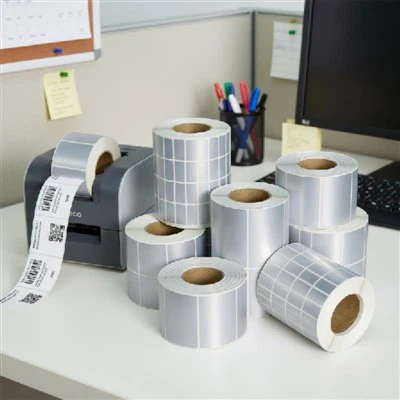
Hey there! As a supplier of high temperature labels, I often get asked some interesting questions. One question that pops up quite a bit is, "Do high temperature labels have a thermal conductivity property?" Well, let's dive right into it and find out.
First off, let's understand what high temperature labels are. These labels are designed to withstand extreme heat conditions without losing their adhesion, readability, or integrity. They're used in a variety of industries, like automotive, aerospace, and manufacturing, where things can get pretty toasty.


Now, when it comes to thermal conductivity, it's all about how well a material can transfer heat. In simple terms, if a material has high thermal conductivity, heat can move through it easily. If it has low thermal conductivity, it acts more like an insulator, slowing down the heat transfer.
So, do high temperature labels have thermal conductivity? The answer is yes, but it depends on a few factors. The materials used to make the labels play a huge role. For example, labels made with metallic foils tend to have higher thermal conductivity compared to those made with paper or some plastics. Metallic foils, like aluminum, are great conductors of heat. They allow heat to flow through them quickly, which can be useful in certain applications.
Let's say you're in the automotive industry. You might use high temperature labels on engine components. These labels need to be able to handle the intense heat generated by the engine. A label with some thermal conductivity can help dissipate the heat, preventing it from building up and potentially damaging the label or the component it's attached to.
On the other hand, there are situations where you might want a label with low thermal conductivity. For instance, in some electronic devices, you don't want heat from the device to transfer to the label and cause it to warp or lose its adhesive. In these cases, labels made from materials with low thermal conductivity, like certain types of plastics or ceramics, would be a better choice.
Another factor that affects the thermal conductivity of high temperature labels is the thickness of the label. Thicker labels generally have lower thermal conductivity because there's more material for the heat to pass through. This can act as a barrier, slowing down the heat transfer.
Now, let's talk about how this property of thermal conductivity can impact the performance of high temperature labels. If a label has too high of a thermal conductivity, it might not be able to maintain its adhesion at high temperatures. The heat can cause the adhesive to soften or melt, leading to the label peeling off. On the other hand, if the thermal conductivity is too low, the label might not be able to handle sudden changes in temperature well. It could crack or delaminate due to the stress caused by the temperature difference.
As a supplier, I've seen firsthand how important it is to choose the right high temperature label based on its thermal conductivity. That's why we offer a wide range of labels with different thermal properties to meet the specific needs of our customers. Whether you need a label that can quickly transfer heat or one that acts as an insulator, we've got you covered.
If you're in the market for high temperature labels, you might also be interested in some of our other products. We offer Heavy Duty Wrapping Film, which is perfect for protecting your products during shipping and storage. It's strong and durable, and can withstand a lot of wear and tear. We also have Hand Roll Plastic Wrap, which is great for smaller projects or for wrapping items by hand. And if you're looking for labels with a bit more functionality, check out our Qr Packaging Labels. These labels can contain QR codes that can provide additional information about your product, like its origin, ingredients, or usage instructions.
In conclusion, high temperature labels do have a thermal conductivity property, and it's an important factor to consider when choosing the right label for your application. Whether you need a label with high or low thermal conductivity, we can help you find the perfect solution. If you have any questions or want to discuss your specific needs, don't hesitate to reach out. We're here to make sure you get the best products for your business.
References
- "Thermal Conductivity of Materials" - A general textbook on material science
- "High Temperature Label Applications in Industry" - An industry - specific research paper