It's Not Just the Glue: The Hidden Physics Behind Cable Wrap Label Failures

When a cable label peels, curls, or flags, the instinct is to blame the adhesive. Buy a stickier glue. Try a different brand. Add more pressure. Sometimes that helps for a few days. Then the label lifts again.
The real problem is usually not the glue. It is physics. A cable is a curved, moving, often contaminated surface. A label wrapped around it is a thin film fighting to return to its flat shape. That fight-between the label's memory and the cable's geometry-is what determines whether the label stays put. If the material and the adhesive are not matched to the physics, no amount of tack will save it.
The First Force: Restoring Force
Why a Flat Label Wants to Spring Back
Every material has a natural shape. Bend it, and it wants to return to that shape. Think of a plastic ruler: bend it, let go, and it springs back. That spring-back is called restoring force .
When a label wraps around a cable, it is being bent into a curve. A stiff label resists that curve. It wants to go back to being flat. That restoring force pulls the label's edges away from the cable, while the adhesive is left fighting a constant, gentle pull .
Why Small Cables Make It Worse
A typical cable diameter is only 3 mm to 8 mm . Wrapping a label around such a small circle forces it into a tight curve. The tighter the curve, the stronger the restoring force .
This is why a label that works perfectly on a flat carton fails on a cable. The label is not getting weaker. The geometry is making it work harder . Thin, flexible face materials-like soft vinyl, nylon cloth, or thin polyester-bend more easily and generate less restoring force than thick, stiff films . Phoenix Contact's EMLC cloth labels, for example, are built on a textile foil with "very low restoring forces," specifically to stick over edges and curves .
The Second Force: The Curvature Trap
Flagging and Butterflying
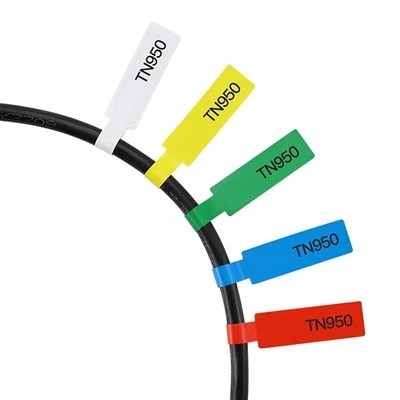
When restoring force wins, the label's ends lift away from the cable. The industry calls this flagging or the butterfly effect . Once a label flags, it catches on adjacent wires, tears, or peels completely .
The problem is not just that the label looks bad. A flagged label is no longer a reliable identifier. It can interfere with cable management, create a safety hazard, and lead to maintenance errors .
The Wrap Must Be Wide Enough
A label that is too narrow for the cable diameter cannot wrap far enough around the circumference. The overlap is insufficient, and the label springs open . The wrap must be designed for the specific cable diameter, not chosen from a generic size chart. This is where custom sizing becomes a functional requirement, not a cosmetic choice.
Self-Laminating Wraps Distribute the Stress
One solution is a self-laminating wrap. The label wraps around the entire cable and overlaps onto itself. The clear overlay bonds to the printed area and to itself, creating a continuous sleeve that distributes stress across the full circumference instead of concentrating it at one edge . The overlap also seals the adhesive from moisture and dirt .
The Third Force: The Cable Jacket Fights Back
Low Surface Energy
Many cable jackets are made from plastics designed to resist sticking-polyethylene (PE), polypropylene (PP), and silicone. These materials have low surface energy, meaning adhesives cannot wet out and form a proper molecular bond . A surface energy below roughly 34 dynes/cm is generally considered difficult to bond with standard pressure-sensitive adhesives .
Plasticizers and Contamination
Cable jackets can contain plasticizers that migrate to the surface over time. They also arrive from the factory coated in release agents, oils, and dust . Even fingerprints from handling can leave enough residue to prevent bonding . A label that adheres perfectly to a clean laboratory surface may fail on the actual cable because the surface it is bonding to is chemically different.
The Adhesive Must Match the Jacket
A standard acrylic adhesive that works on PVC may fail on PE or PP. Rubber-based or specially formulated LSE (low surface energy) adhesives are often required for these challenging jackets . The adhesive must be selected for the specific jacket material, not just for "cable" in general. This is a specification that a production factory with cable-label experience can match to your actual cable construction.
The Fourth Force: Heat, Cold, and Movement
Thermal Cycling
Cables expand and contract with temperature changes . A label bonded at 20°C may experience a very different stress state at -20°C or at 80°C. Cold temperatures can make the adhesive firm and brittle before it has built full bond strength . Sustained heat can soften the adhesive and allow the label to slide or creep .
Vibration and Flexing
Cables in machinery, vehicles, or moving equipment are constantly flexing and vibrating. A label that is not designed for dynamic movement will gradually lose adhesion, even if the initial bond was strong. The adhesive must maintain cohesion under shear stress, not just high initial tack .
How to Specify a Label That Works With the Physics
Step 1: Measure the Cable Diameter and Jacket Material
The cable's outside diameter and jacket chemistry are the starting point. A label for a 3 mm PE cable needs a very different construction from a label for a 10 mm PVC cable. Record the jacket material-PVC, PE, PP, LSZH, or something else-and share it with your supplier .
Step 2: Choose a Low-Restoring-Force Face Material
Specify a thin, conformable face material. Nylon cloth, soft vinyl, and thin polyester films generate less restoring force than stiff BOPP or thick PET . If the cable is very small or the bend radius is tight, a cloth or textile-based label may be the only construction that stays flat.
Step 3: Match the Adhesive to the Jacket, Not Just the Application
A general-purpose adhesive is not enough. For PE and PP jackets, specify an adhesive rated for low-surface-energy plastics. For PVC, a standard acrylic may work. For cables that will see heat, cold, or flexing, confirm the adhesive's service temperature range and shear resistance .
Step 4: Design the Wrap for Full Coverage
A wrap-around or self-laminating construction distributes stress and seals the adhesive from contamination . The label must be wide enough to overlap sufficiently for the specific cable diameter. A custom wrap dimension, built for your cable, is more reliable than a one-size-fits-all stock label.
Step 5: Test on the Actual Cable Under Real Conditions
A laboratory test on a glass plate does not predict performance on a PE cable jacket. Apply samples to your actual cable, under your actual tension and temperature conditions. Bend it, flex it, and leave it for weeks. Check for edge lift, flagging, and adhesive failure. A production factory can provide test data and samples matched to your cable specification. For brands using an OEM model, the specification must include the jacket material, cable diameter, temperature range, and required service life so the factory can hold those parameters consistent across production batches.
FAQ
Q1: Why does my cable label keep peeling even though the adhesive is strong?
A: A strong adhesive cannot overcome a stiff label on a tight curve. The label's restoring force-its tendency to return to a flat shape-pulls the edges away from the cable continuously. The fix is a more flexible face material, not just more adhesive .
Q2: What is "flagging" or the "butterfly effect" on a cable label?
A: Flagging is when the ends of a wrapped label lift away from the cable instead of lying flat. It happens when the label's restoring force is stronger than the adhesive's ability to hold it against the curve. The label's ends flare out like wings, hence the name .
Q3: Why do labels fail on some cables but not others?
A: Cable jacket materials vary widely. PVC bonds relatively well with standard adhesives. PE, PP, and silicone have low surface energy and resist bonding. Plasticizers, release agents, and dust on the jacket further reduce adhesion. A label specified for PVC may fail completely on a PE cable .
Q4: Does a thicker adhesive layer fix cable label failures?
A: Not usually. A thicker adhesive layer can provide more conformability, but it does not change the restoring force of a stiff face material. The material's stiffness must be matched to the cable's curvature. A thin, flexible film with a moderate adhesive often outperforms a thick adhesive on a stiff film .
Q5: What is a self-laminating wrap label?
A: A self-laminating wrap label uses a clear film that wraps around the entire cable and overlaps onto itself. The clear layer bonds to the printed area and to itself, creating a sleeve that distributes stress across the circumference and seals the adhesive from moisture and dirt .