Adhesive That Never Touches the Jewelry: How Pattern-Coated Labels Stick Without Damage

A gold ring is easy to scratch. A pearl is easy to stain. A watch band is easy to scuff. Yet every piece of jewelry sold in a store needs a tag - for the price, the SKU, the metal type, or the gemstone details. The challenge is simple to state and surprisingly hard to solve: how do you attach a label firmly enough to stay put, without letting adhesive ever touch the jewelry itself?
Pattern-coated labels are the answer. They apply adhesive only where it is needed, leaving the area that contacts the jewelry completely clean. This guide explains how they work, why they matter, and how to choose the right one.
Why Ordinary Labels Damage Jewelry
The Residue Problem
A standard pressure-sensitive label has adhesive across its entire back. When it wraps around a ring or a chain, adhesive touches the metal, the stone, or the plating. Even a "removable" adhesive can leave a sticky film that attracts dust, dulls the finish, or reacts with skin oils over time.
For high-value pieces - gold, silver, platinum, pearls, opals, and watches - residue is not just an inconvenience. It can require professional cleaning, reduce perceived value, or even cause permanent surface damage.
The Handling Problem
Jewelry tags are often applied by hand in busy retail environments. A label with adhesive everywhere is difficult to position accurately. It may stick to fingers, fold onto itself, or bond to the wrong part of the item before the user can adjust it. Pattern-coated labels solve this by giving the user clean, non-tacky areas to hold and position.
How Pattern-Coated Labels Work
The Core Principle: Adhesive Only Where Needed
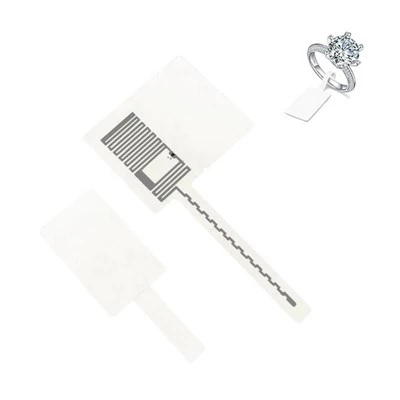
A pattern-coated label - also called a partial-gum, D-gum, or patterned adhesive label - has adhesive applied in a specific pattern rather than across the entire back. The most common jewelry design places adhesive on both ends and leaves the center clean. When the label wraps around a ring or chain, the two gummed ends bond to each other, while the clean center faces the jewelry.
The adhesive never touches the product. The label holds securely because the two ends are bonded together, not because the label is glued to the jewelry.
Common Adhesive Patterns
Several patterns are used in jewelry labeling:
End-to-end (D-gum): Adhesive on both ends, clean center. The label wraps around the item and the ends stick together. This is the most common jewelry label design.
Center adhesive: Adhesive in the middle, clean ends. Used when the label needs to stick to a display card while the ends remain free for handling.
Rat tail: A narrow, non-adhesive strip at one end. The gummed section secures the label, while the tail provides a clean handling point or threads through a loop.
Full gum with fold: Adhesive across the entire back, but the label is folded so that adhesive touches only adhesive, never the jewelry.
The Folded Variant
A folded label works differently but achieves the same goal. The label is folded along a line so that the adhesive side bonds to itself, creating a secure loop around the jewelry. The jewelry sits inside the loop, untouched by adhesive. Folded labels are common for rings, earrings, and small pendants.
Materials That Protect Delicate Surfaces
Face Materials for Jewelry Labels
The face material - what you see and print on - must be soft, flexible, and safe for contact with jewelry. Common choices include:
PP (polypropylene) film: Waterproof, tear-resistant, and smooth. It does not shed fibers and is gentle on metal and stone surfaces.
PET (polyester) film: Stronger and more dimensionally stable than PP. Suitable for higher-value items and longer retail cycles.
Coated paper: Economical and printable, but less durable in humid environments. Best for short-term use.
Adhesive Selection
Even though the adhesive does not touch the jewelry, its properties still matter. A low-tack adhesive is easier to peel and reposition during application. A high-tack adhesive holds more securely on heavy items. For items that will be handled frequently, a permanent adhesive on the gummed ends ensures the label does not open accidentally.
Testing for Surface Compatibility
Before committing to a large order, test the label on your actual jewelry. Apply the label, leave it for a few days, and remove it. Check for any transfer, dulling, or discoloration. Even a clean-center label can cause problems if the face material itself reacts with the jewelry surface.
Where Pattern-Coated Labels Are Used
Retail Jewelry
Retailers use pattern-coated labels for price tags, SKU labels, and security tags on rings, necklaces, bracelets, and earrings. The clean center protects the item, while the gummed ends provide a secure hold.
Watches and Optical Frames
Watch bands and optical frames have curved, delicate surfaces that are easily damaged by adhesive. Rat-tail and end-to-end labels are common in these applications because they wrap around the band or temple without adhesive contact.
Gemstones and Pearls
Loose gemstones and pearls are especially vulnerable. A pattern-coated label with a soft PP face and a clean center allows the stone to be tagged without any risk of adhesive residue on the surface.
Repair and Service Tags
Jewelry repair shops use pattern-coated labels to tag items during service. The label identifies the customer and the work order, while the clean center ensures the piece is not damaged during storage or handling.
How to Choose the Right Pattern-Coated Label
Step 1: Determine the Adhesive Pattern You Need
Ask yourself: How will the label wrap around the item? Does it need adhesive on both ends, one end, or the center? A simple sketch of the adhesive zones eliminates most ordering errors. Describe the application, not just the label name.
Step 2: Match the Face Material to the Item
For delicate stones and polished metal, choose a soft PP or PET film. For short-term retail use, coated paper may be sufficient. Avoid materials that shed fibers or contain plasticizers that could migrate onto the jewelry surface.
Step 3: Confirm the Fold Direction If Applicable
If your label folds, specify whether it folds top-to-bottom or left-to-right. This affects how the label sits on the jewelry and how much information remains visible.
Step 4: Test with Real Jewelry
Order samples and apply them to your actual products. Check that the clean center stays clean, the gummed ends hold securely, and the label can be removed without residue. A small test prevents a large mistake.
FAQ
Q1: What is a pattern-coated label?
A: A pattern-coated label has adhesive applied in a specific pattern rather than across the entire back. The most common jewelry design has adhesive on both ends and a clean center, so the adhesive never touches the jewelry.
Q2: How does the label stay on if the adhesive doesn't touch the jewelry?
A: The label wraps around the item, and the two gummed ends bond to each other. The label holds because the ends are stuck together, not because the label is glued to the jewelry.
Q3: What is a D-gum label?
A: D-gum is a term used in some markets for a jewelry label with adhesive on both ends and a non-adhesive center. The adhesive pattern resembles a D shape when the label is laid flat.
Q4: Can pattern-coated labels be used on pearls and opals?
A: Yes. These are among the most delicate surfaces, and pattern-coated labels are ideal because no adhesive touches the stone. Choose a soft PP face material and test on a sample before a full order.
Q5: Are pattern-coated labels more expensive than standard labels?
A: They cost slightly more because the adhesive pattern requires a specialized coating process. However, the cost is offset by reduced damage, fewer returns, and less time spent cleaning residue from jewelry.